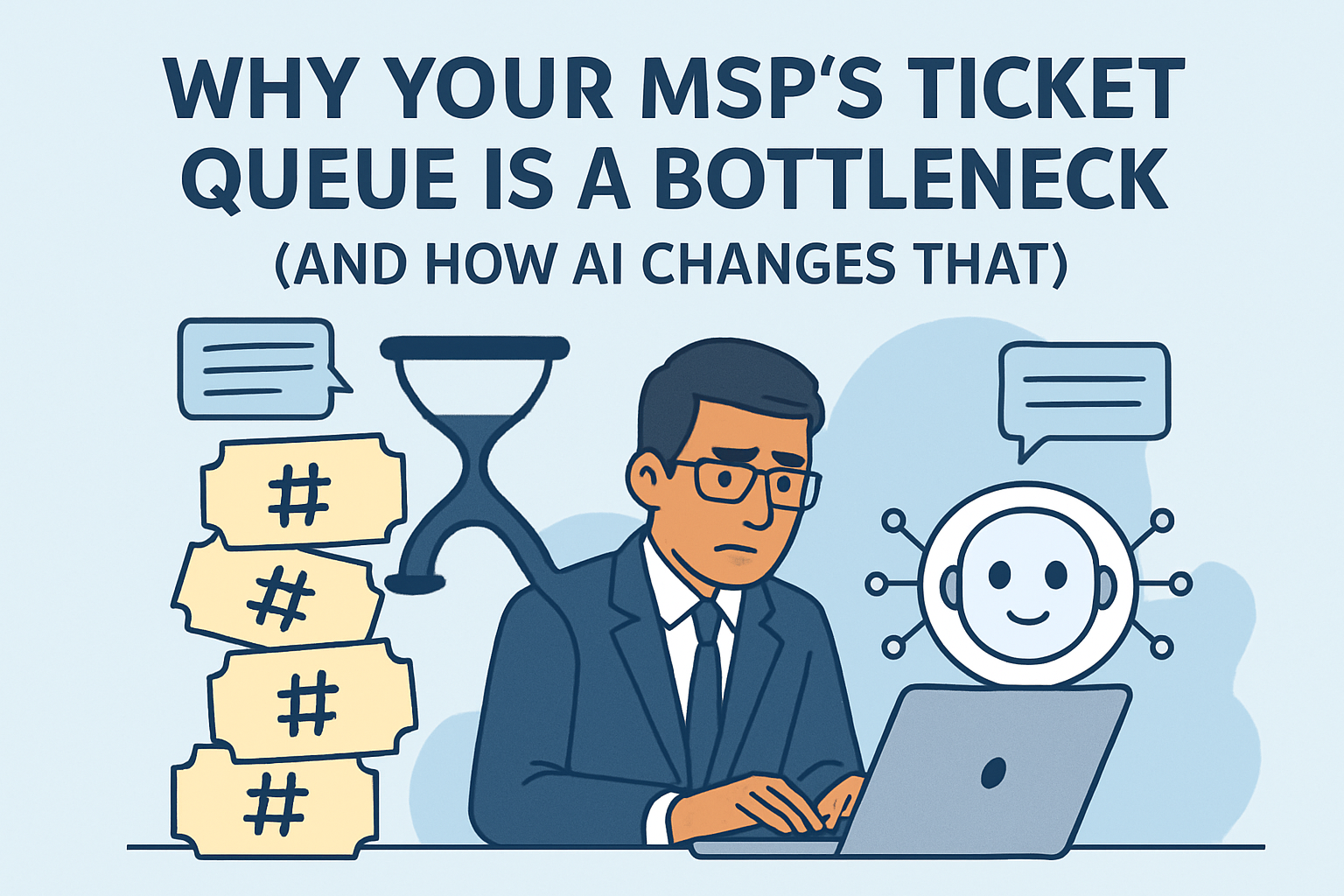
Every MSP hits the same wall. You sign a new client, tickets increase, your team works harder, but response times creep up and quality gets inconsistent. You hire another technician, margins tighten, things stabilize — until the next client pushes you back to the same breaking point. The common denominator in this cycle isn’t headcount, tools, or talent. It’s the ticket queue.
The ticket queue is where every client interaction starts and where your team’s capacity is consumed. It’s the bottleneck that determines how many clients you can serve, how fast you can respond, and whether your growth is sustainable or just adding pressure. And for most MSPs, the bottleneck isn’t the tickets themselves — it’s what happens before a technician starts working on one.
The Manual Triage Loop
We’ve written about the hidden cost of L1 triage before, but it’s worth zooming out to see how that cost creates a systemic bottleneck.
When a ticket enters the queue, a predictable sequence begins:
- Read and interpret the request
- Look up the user, device, and client context
- Search documentation for relevant SOPs or known issues
- Categorize the ticket by type, priority, and SLA tier
- Route it to the right person or team
- Begin the actual work
Steps 1 through 5 are triage. Step 6 is where value is delivered. The problem is that triage consumes 30-40% of a technician’s day — hours spent on research, context-switching between tools, and administrative categorization before any problem-solving begins.
This loop runs on every ticket. It doesn’t scale. And it’s the reason your queue grows faster than your team can work through it.
Why the Queue Becomes the Constraint
Linear Scaling, Linear Cost
In a manual triage model, every new ticket requires human attention from the moment it arrives. More clients mean more tickets. More tickets require more technicians doing the same triage loop. Your cost of service delivery scales linearly with your client count.
This is fundamentally different from how your tools scale. ConnectWise doesn’t care if you have 500 tickets or 5,000 — the software cost is the same. NinjaOne’s per-device pricing scales, but efficiently. Your technician labor does not. It’s the most expensive and least scalable resource in your operation, and the triage loop maximizes how much of it you consume.
Quality Degrades Under Pressure
When the queue is long and technicians are rushed, corners get cut. Documentation doesn’t get checked. Historical tickets don’t get reviewed. Categorization gets less precise. The technician who normally spends 8 minutes triaging a ticket spends 3, and the resulting work is lower quality — not because they’re less capable, but because the queue pressure leaves no room for thoroughness.
This creates a vicious cycle: rushed triage leads to incomplete context, which leads to longer resolution times, which leads to more tickets stacking up, which increases pressure further.
Inconsistency Compounds
Manual triage depends on individual technicians. Your senior tech catches patterns across related tickets, checks documentation proactively, and routes escalations with detailed notes. Your newest hire does their best but misses things a veteran would catch. The client experience varies based on who picks up the ticket — and the client doesn’t know or care that it’s a staffing-dependent variable.
Over time, this inconsistency erodes trust. A client who gets excellent service on Monday and mediocre service on Friday doesn’t average them out. They remember Friday.
The Growth Ceiling
This is where it becomes an existential business problem. MSPs grow by adding clients. Adding clients adds tickets. Adding tickets requires adding technicians — or burning out the ones you have. But adding technicians requires the revenue from adding clients, and the margin on those clients is already compressed by the triage overhead.
You can’t grow without hiring. You can’t hire without growing. The ticket queue is the constraint that creates this deadlock.
How AI Collapses the Triage Loop
AI doesn’t just speed up triage — it fundamentally changes the model. Instead of a human performing each step of the triage loop sequentially, AI processors handle the entire pipeline in parallel, in seconds, before a technician ever touches the ticket.
Research Happens Instantly
User lookup, device context, documentation search, historical ticket analysis — all of the information-gathering steps that take a technician 5-15 minutes happen automatically when the ticket arrives. The AI pulls from ConnectWise, NinjaOne, ITGlue, M365, Sophos, and Pax8 simultaneously. Every tool, one query.
Classification Is Consistent
AI classification doesn’t vary by who’s on shift, how long the queue is, or whether it’s Monday morning or Friday afternoon. Every ticket gets the same depth of analysis. Priority is assessed based on the actual content, client SLA, and historical patterns — not a quick judgment call from a technician trying to clear the board.
Routing Is Intelligent
With full context — classification, priority, client requirements, technician availability and expertise — routing decisions are more accurate. The right ticket reaches the right person on the first assignment, reducing ping-pong escalations and reassignments that waste time and frustrate clients.
Noise Is Eliminated
Catchall spam, automated notifications, and auto-replies are filtered before they ever reach a technician. The queue reflects actual workload, not noise. Technicians spend their time on real issues, and your metrics reflect genuine performance rather than how fast you can close junk tickets.
Runbooks Handle Repeatable Work
Common processes — password resets, onboarding, offboarding, device troubleshooting, incident response — are handled by structured runbooks that guide or execute the steps with technician approval. The technician’s role shifts from performer to approver for the tasks that follow predictable patterns.
What Changes When the Bottleneck Breaks
When AI collapses the triage loop, the economics of MSP service delivery change in fundamental ways.
Sublinear Scaling
Adding a new client still adds tickets, but those tickets no longer require proportional human attention for triage. The AI handles the research and categorization for every ticket regardless of volume. Your technicians focus their time on the resolution work that requires human judgment and expertise. You grow your client base without linearly growing your headcount.
Consistent Quality Regardless of Volume
Every ticket gets the same thorough triage whether the queue has 10 tickets or 100. Monday morning doesn’t look different from Wednesday afternoon. Your newest technician gets the same context package as your most experienced one. The client experience stabilizes because it no longer depends on who’s working or how busy the queue is.
Technicians Do What They’re Good At
The work that drove technicians into IT — solving problems, helping people, building systems — is what they actually spend their time doing. The work that drives burnout — repetitive lookups, copy-pasting between tools, categorizing tickets — is handled by AI. Retention improves because the job is more satisfying, and productivity improves because technicians start every ticket from a position of knowledge.
Margins Improve
Less technician time per ticket means lower cost of delivery. Lower cost of delivery means healthier margins on existing contracts and the ability to price competitively for new clients without sacrificing profitability. The growth ceiling lifts because adding clients generates net margin rather than just net revenue.
The Future of the MSP Help Desk
The trajectory is clear. Manual triage is a bottleneck that constrains every MSP’s growth, and AI is the tool that eliminates it. Not by replacing technicians — by replacing the research, categorization, and routing work that was never the best use of technician time in the first place.
The human stays in the loop. Technicians still make the calls, still interact with clients, still solve the problems that require expertise and judgment. But they do it from a starting point of full context rather than a blank screen, and they do it for a higher percentage of their working day.
The MSPs that adopt this model first don’t just become more efficient — they become structurally capable of growth that their competitors can’t match without following the same path. The ticket queue stops being the constraint and starts being the engine.
Ready to transform your triage workflow? Start with Junto and break the bottleneck that’s holding your MSP back.